In this article
Enzymes are the catalysts of life. They make digestion, energy production and DNA copying possible, and they are now used in place of harsh chemicals in many industries. This guide explains what enzymes are, how they work, what affects their activity and how they are classified. It also shows where they matter for health, industry and the environment.
Enzymes in brief
An enzyme is a biological catalyst. Almost all enzymes are proteins, although a few RNA molecules also have catalytic activity. Like any catalyst, an enzyme speeds up a reaction without being used up, so a single enzyme molecule can process many substrate molecules, one after another.
What sets enzymes apart from chemical catalysts is their specificity. Each enzyme acts on a particular substrate, or a narrow group of substrates, and catalyses a particular reaction. Amylase breaks starch but not protein, for example, and lactase acts on lactose but not sucrose. This precision is why enzymes are so useful in medicine, food and industry. Some enzymes also need a helper to work: a cofactor such as a metal ion, or a coenzyme derived from a vitamin.
How enzymes work
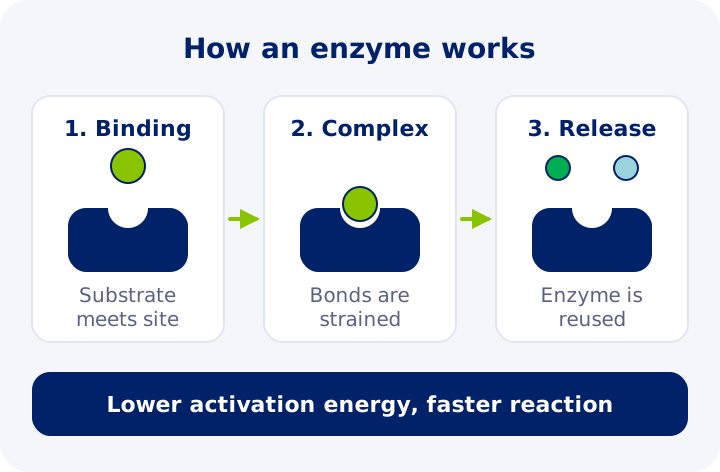
Every enzyme has an active site, a pocket or groove shaped to fit its substrate. The early “lock and key” model described this fit as rigid. The more accurate “induced fit” model recognises that the enzyme changes shape slightly as the substrate binds, gripping it more closely.
Once bound, the enzyme and substrate form an enzyme-substrate complex. The enzyme positions chemical groups so that the target bonds are strained or the reacting groups are brought together. This lowers the activation energy, the energy barrier the reaction has to overcome. The products are then released and the enzyme is free to bind another substrate molecule.
What affects enzyme activity
Because enzymes depend on their folded shape, their activity responds to conditions:
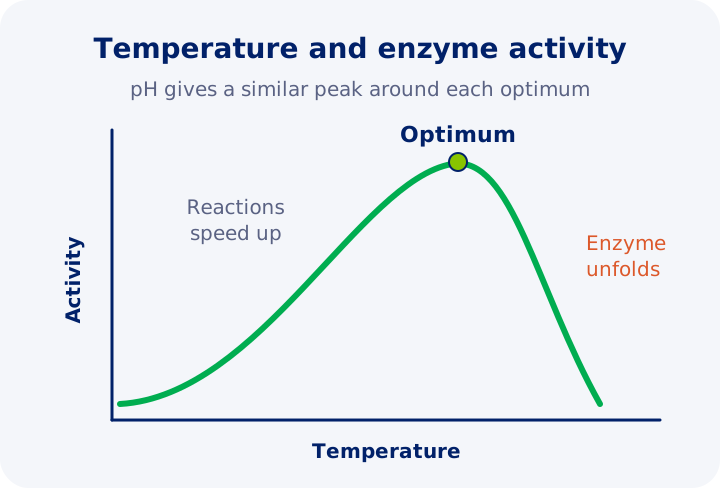
- Temperature: activity rises as temperature increases, because molecules collide more often. Above the optimum, the protein begins to unfold (denature) and activity falls sharply.
- pH: each enzyme has a pH range where it works best. Pepsin works in the acidic stomach, while trypsin prefers the slightly alkaline small intestine. Outside its range, the charges in the active site change and activity drops.
- Substrate concentration: more substrate gives faster reaction until the enzyme is saturated. After that, adding substrate makes little difference.
- Inhibitors and cofactors: some molecules block the active site or change the enzyme’s shape. Others, such as certain metal ions, are needed for activity.
The main classes of enzymes
The international Enzyme Commission (EC) system groups enzymes by the reaction they catalyse. There are seven classes. The seventh, translocases, was added in 2018 for enzymes that move molecules across membranes. The six classic classes are summarised below.
| EC class | Reaction type | Example enzyme |
|---|---|---|
| Oxidoreductases | Transfer electrons (oxidation and reduction) | Glucose oxidase |
| Transferases | Move a chemical group between molecules | Transglutaminase |
| Hydrolases | Split bonds using water | Amylase, protease, lipase |
| Lyases | Break bonds without water or oxidation | Pectate lyase |
| Isomerases | Rearrange atoms within a molecule | Glucose isomerase |
| Ligases | Join molecules using energy | DNA ligase |
Most industrial enzymes are hydrolases, because so many processes involve breaking down starch, protein, fat or fibre.
How enzyme activity is measured
Because enzymes are catalysts, they are measured by what they do, not by how much protein is present. Activity is the amount of substrate converted per unit of time under defined conditions of temperature, pH and substrate. In science, one common unit (U) is the amount of enzyme that converts one micromole of substrate per minute. The SI unit is the katal.
Commercial enzymes are usually declared in application-specific units, such as ALU for lactase, SKB for fungal amylase or FIP units for lipase. Each is linked to its own assay. Two products with different units cannot be compared on paper, so buyers specify activity, state the method and confirm performance in trials.
Enzymes in the human body
The body relies on thousands of enzymes. Some of the best-known roles are:
- Digestion: amylases, proteases and lipases break food into absorbable units, and lactase splits milk sugar.
- Metabolism: chains of enzymes convert glucose and fats into usable energy and build the molecules cells need.
- DNA copying and repair: DNA polymerases copy genetic material when cells divide, and other enzymes repair damage.
- Defence: lysozyme in tears and saliva breaks down the cell walls of some bacteria.
Enzymes in industry and the environment
Most commercial enzymes are made by fermentation of selected fungi or bacteria. A few, such as papain and pepsin, come from plant or animal sources. Because enzymes work under mild conditions and target specific bonds, they can replace harsher chemicals in many processes:
- Detergents: proteases, amylases and lipases remove stains at lower wash temperatures, which can reduce energy use. See our detergent enzymes.
- Textiles: amylases remove starch size, and other enzymes are used for scouring and bio-polishing, which can reduce chemical load.
- Animal feed: phytase releases phosphorus from plant phytate, which can reduce the need for added mineral phosphate and lower the phosphorus in manure. Explore our feed enzymes.
- Leather: enzymes are used in soaking, dehairing and bating, reducing reliance on some harsh chemicals.
- Food and baking: enzymes improve dough handling, dairy processing and juice yield.
Tip: An enzyme's performance depends on the conditions in your process. Always confirm the dose with a small-scale trial at your own temperature, pH and time.
To browse enzymes by application, use our product finder. For a look at where the technology is heading, read the future of enzyme applications.
Working with Enzyme Bioscience
We manufacture more than 100 enzymes and probiotic strains for pharma, food, feed, textile, detergent and leather customers. If you are evaluating enzymes for a new process, request samples and a TDS and our team will help you choose a starting point.
Frequently asked questions
An enzyme is a biological catalyst, usually a protein, that speeds up a specific chemical reaction. It is not used up, so one enzyme molecule can act on many substrate molecules. Living cells depend on thousands of different enzymes.
An enzyme binds its substrate in a pocket called the active site and holds it in a position that makes the reaction easier. This lowers the activation energy, the energy barrier the reaction must overcome, so the reaction runs much faster at normal temperatures.
Enzymes depend on their folded three-dimensional shape. Above a certain temperature the protein starts to unfold, or denature, and the active site loses its shape. Activity then falls sharply, and the loss is often permanent.
Enzymes are classified into seven classes: oxidoreductases, transferases, hydrolases, lyases, isomerases, ligases and translocases. Hydrolases, which split bonds using water, include amylases, proteases and lipases and are the most widely used in industry.
Most industrial enzymes are made by fermentation, growing selected microorganisms such as fungi or bacteria that secrete the enzyme. The enzyme is then recovered, purified and standardised to a declared activity. Some, such as papain, come from plants, and others, such as pepsin, from animal tissue.