In this article
- Where enzymes already make a difference
- Trend 1: engineering better enzymes
- Trend 2: computational and AI-guided design
- Trend 3: biocatalysis replacing harsh chemistry
- Trend 4: lower-energy processing
- Trend 5: research-stage frontiers
- Challenges that remain
- What this means for manufacturers today
- Working with Enzyme Bioscience
Enzymes are already part of everyday industry, from washing powders to bread to animal feed. What is changing is how enzymes are designed and how many processes they can reach. This article looks at the trends shaping enzyme applications and separates what is established from what is still emerging. It also considers what these trends mean for manufacturers planning their next process improvement.
Where enzymes already make a difference
Before looking ahead, it helps to recognise how far enzymes have already spread. Detergent proteases and amylases let consumers wash at lower temperatures. Amylases remove starch size from woven fabric, and bio-scouring enzymes can replace part of the caustic treatment of cotton. Phytase in poultry and pig feed releases phosphorus from plant material, which can reduce the need for added mineral phosphate. Bakery enzymes improve dough handling and freshness. In pharmaceutical manufacturing, enzymes now perform selected steps in the synthesis of several medicines.
These are mature applications. The next wave builds on them in three ways: better enzymes, faster discovery and new processes.
Trend 1: engineering better enzymes
Natural enzymes evolved for life inside cells, not for hot, alkaline or solvent-rich industrial processes. Protein engineering closes that gap. The most influential method is directed evolution, which earned Frances Arnold a share of the 2018 Nobel Prize in Chemistry.
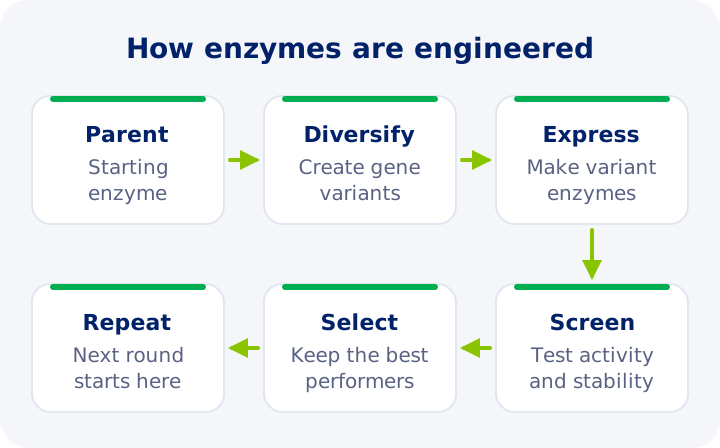
In directed evolution, scientists create many variants of an enzyme’s gene and express the variant enzymes. They then screen them for a target property, such as heat stability or activity at a particular pH. The best performers become the starting point for the next round. After several cycles, the enzyme can be far better suited to the process than the original.
Engineered enzymes are already common in detergents, starch processing and feed. Examples include phytases that survive feed pelleting and amylases that work across a wider temperature range.
Trend 2: computational and AI-guided design
Protein structure prediction has advanced rapidly. The 2024 Nobel Prize in Chemistry recognised both computational protein design and AI-based structure prediction. For enzyme developers, these tools help in three ways:
- Prioritising variants: predicting which mutations are likely to improve stability or activity, so fewer variants need to be made.
- Mining sequence databases: finding new natural enzymes with useful properties from genomic data.
- Designing new functions: creating proteins for reactions that natural enzymes do not perform well.
These tools speed up discovery, but they do not replace testing. A predicted improvement still has to be confirmed with real substrates, at real process temperatures and pH.
Trend 3: biocatalysis replacing harsh chemistry
Green chemistry aims to cut hazardous reagents, energy use and waste. Enzymes fit this goal well. They work in water at moderate temperatures, and they are selective enough to change one bond without protecting the rest of the molecule.
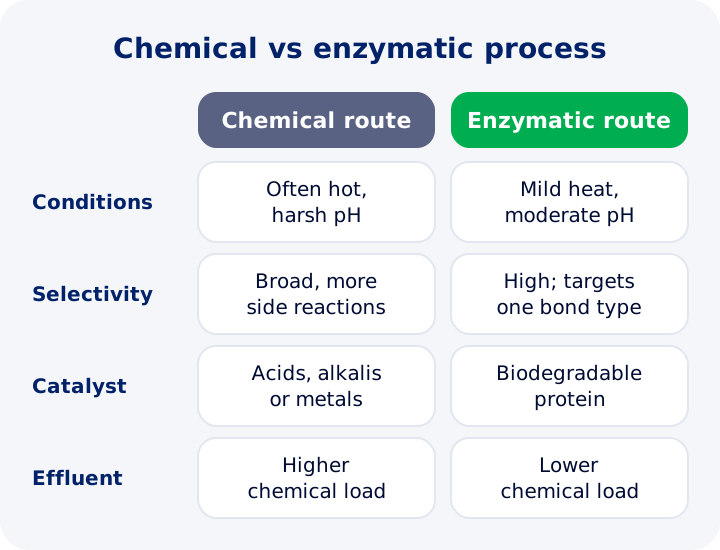
In pharmaceutical manufacturing, biocatalysis is established for selected steps, especially where a single mirror-image form of a molecule is needed. Similar thinking applies elsewhere. Enzymatic desizing and bio-scouring in textile processing, enzymatic soaking and bating in leather, and enzyme-based cleaning all reduce reliance on harsher chemicals.
Trend 4: lower-energy processing
Many enzyme benefits come from doing the same job at a lower temperature or in a shorter time. Cold-wash detergent formulations depend on enzymes that stay active at low temperatures. In feed, enzymes such as phytase, xylanase and beta-glucanase help animals get more value from plant ingredients, which gives nutritionists more flexibility in raw material choice. In food processing, enzymes can raise yields and reduce waste streams.
Trend 5: research-stage frontiers
Some of the most discussed applications are still being proven at scale:
- Plastic recycling: enzymes that break PET into its building blocks have been demonstrated, and companies are working on scaling enzymatic recycling.
- Biomass conversion: cellulases and hemicellulases can turn plant residues into fermentable sugars, but the overall economics remain challenging.
- Carbon capture and new chemistry: enzymes are being studied for capturing carbon dioxide and for reactions not seen in nature.
| Trend | What it changes | Maturity today |
|---|---|---|
| Engineered enzymes | Stability and fit to process | Established and growing |
| AI-guided design | Speed of discovery | Emerging, fast-moving |
| Pharma biocatalysis | Fewer steps, milder conditions | Established for selected steps |
| Low-temperature processing | Energy and chemical use | Established in detergents and textiles |
| Enzymatic plastic recycling | Breaking PET into monomers | Pilot and demonstration scale |
Challenges that remain
Enzymes are not a universal answer. Production cost, stability in real process conditions and compatibility with other chemicals can all limit adoption. Food and pharmaceutical uses need regulatory approval, which takes time. Scale-up from laboratory to plant often reveals issues that small trials miss. The practical way forward is careful trials with realistic substrates and close work between the enzyme supplier and the process owner.
Tip: When you evaluate a new enzyme, measure energy, water, chemical use and yield before and after the trial. A clear baseline makes the sustainability case far easier to prove.
What this means for manufacturers today
You do not need to wait for research-stage breakthroughs to benefit. Many established enzymes can already replace a harsh chemical step or lower a process temperature. A practical approach is to:
- Map your process: list the steps that use high temperatures, strong acids or alkalis, or large volumes of water.
- Shortlist enzyme options: identify where an enzyme could do the same job under milder conditions.
- Trial at small scale: test with your own raw materials and record yield, quality, energy and chemical use.
- Scale up in stages: confirm results at pilot or partial plant scale before switching fully.
If you are new to the subject, start with our guide to what enzymes are.
Working with Enzyme Bioscience
We have in-house R&D and QC labs, and our ENZYVIVE® custom-blend service can combine enzymes for a specific process. If you are considering an enzymatic step in place of a chemical one, request samples and a TDS to begin trials.
Frequently asked questions
The main trends are engineered enzymes that tolerate tougher process conditions, computational design that speeds up discovery, wider use of biocatalysis in pharmaceutical manufacture and more enzymatic steps in textiles, detergents and feed. Newer areas such as enzymatic plastic recycling are still being scaled up.
The most widely used method is directed evolution. Scientists create many variants of an enzyme gene, test the resulting enzymes for the property they want, keep the best and repeat the cycle. Rational design based on enzyme structure is often combined with it.
AI and computational tools can predict protein structures and suggest which variants are likely to improve stability or activity. This narrows the number of variants that must be made and tested. The predictions still have to be confirmed in the laboratory and in real process conditions.
Enzymes work under mild conditions, act on specific bonds and are biodegradable proteins. Replacing a harsh chemical step with an enzymatic one can lower process temperatures, reduce chemical use and cut effluent load. The actual benefit depends on the process and should be measured case by case.
Cost, stability under real process conditions, regulatory approval for food and pharmaceutical uses, and scale-up from laboratory to plant are the main hurdles. Application trials with realistic substrates are essential before switching a process.