In this article
Gut health product development is moving quickly, driven by microbiome research and by shoppers who expect products to be both effective and honest. For R&D and QA teams, each new trend brings practical questions about stability, testing and claims. This article looks at five trends shaping gut health formulation in 2025, the challenge each one creates, and the checks that keep products reliable.
For the consumer side of the same market, including shopper personas and the purchase journey, see our companion piece on what gut health consumers want in 2025.
The five trends at a glance
| Trend | Key R&D question | Essential QA check |
|---|---|---|
| Next-generation probiotics | Can the strain survive oxygen and drying? | Viable count under anaerobic handling |
| Synbiotics | Do the fibre and strain stay compatible? | Count and moisture over shelf life |
| Postbiotics | What exactly is the active preparation? | Defined inactivation and composition |
| Personalised nutrition | Can formulas flex without losing control? | Batch records for each variant |
| Gut-brain axis | Is the evidence strain-specific and human? | Claim review per market |
1. Next-generation probiotics
Traditional probiotics are mostly lactic acid bacteria, such as Lactobacillus species, and bifidobacteria. Research interest has widened to other gut commensals, such as Akkermansia muciniphila and Faecalibacterium prausnitzii, that are studied for their roles in the gut lining and in producing short-chain fatty acids.
The formulation challenge is significant. Many of these organisms are strict anaerobes, so oxygen exposure during fermentation, drying and packing can sharply reduce viability. Several are also new to the food supply, so novel food or equivalent approvals may be needed before sale in some markets.
R&D actions:
- Plan anaerobic handling and oxygen-barrier packaging from the start.
- Confirm strain identity with genomic methods and keep a clear strain designation.
- Check regulatory status in each target market before investing in scale-up.
2. Synbiotics
A synbiotic combines live microorganisms with a substrate, often a fibre, that is selectively used by microbes. The idea is that the two work together, either because the fibre supports the added strain or because both are chosen to act on the gut community.
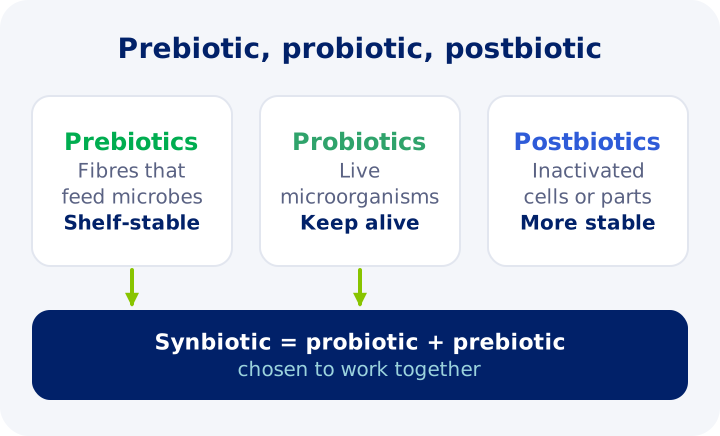
The practical issue is compatibility. Some fibres are hygroscopic and can raise water activity in a powder, which shortens probiotic shelf life. Dose matters too: the amount of fibre that can be used is limited by tolerance and by format.
R&D actions:
- Run stability studies on the combined product, not on each ingredient separately.
- Monitor moisture and water activity alongside viable counts.
- Keep fibre and strain specifications tight, because small changes can alter stability.
For more on pairing live cultures with other actives, see our article on enzyme and probiotic synergy.
3. Postbiotics
Postbiotics are preparations of inactivated microorganisms or their components. Because the cells do not need to stay alive, postbiotics avoid many viability problems and can suit formats such as baked goods, drinks or gummies where live cultures struggle.
The trade-off is characterisation. A postbiotic is defined by how it was made: the strain, the growth conditions, the inactivation method and the resulting composition. Two preparations from the same strain can differ if any of these steps change.
R&D actions:
- Document the strain, process and inactivation method in the specification.
- Develop validated analytical methods to confirm batch-to-batch consistency.
- Avoid presenting a postbiotic as interchangeable with its live parent strain.
We cover the commercial side in more depth in the rise of postbiotics.
4. Personalised nutrition and microbiome testing
Microbiome testing and digital tools have encouraged interest in products tailored to individual needs. In practice, most brands personalise through a set of defined variants rather than one-off formulas.
The challenge for R&D and QA is control. More variants mean more specifications, more stability studies and more chance of error. Evidence is also a concern, because the science linking individual microbiome profiles to specific product choices is still developing.
R&D actions:
- Build variants from a small library of well-characterised ingredients.
- Keep full batch records and labelling controls for each variant.
- Keep claims about personalisation factual and modest.
5. The gut-brain axis
The gut and the brain communicate through nerve, immune and metabolic pathways, and research in this area is active. Some strains have been studied for effects on stress or mood, but results are strain-specific and the field is still developing.
This is the trend with the highest regulatory risk. Claims about mood, stress or cognition are closely scrutinised in most markets and need strong human evidence for the exact strain and amount. Our article on the gut-brain axis and mental wellness explains the science in more detail.
R&D actions:
- Select strains with published human data relevant to the intended use.
- Confirm that the amount at the end of shelf life matches the studied amount.
- Involve regulatory reviewers before any wording is drafted.
Tip: Whatever the trend, test viability or activity in the final format and pack. Data on the raw ingredient alone rarely predicts how it behaves in a gummy, tablet or drink.
QA essentials that apply to every trend
Whichever trend a product follows, a common set of quality checks keeps it reliable from first batch to last:
- Identity: confirm the strain or ingredient with suitable methods and keep the designation on every document.
- Potency: measure viable count or enzyme activity with a validated method, and declare the value guaranteed at the end of shelf life.
- Water activity and moisture: track both in dry formats, since they strongly influence probiotic survival.
- Microbiological purity: set and test limits for contaminants appropriate to the product category.
- Documentation: keep a specification, CoA and stability report for each ingredient and for the finished product.
These checks are not new, but newer product types make them more demanding. A synbiotic has two ingredients that interact, a postbiotic needs a defined process, and a personalised range multiplies the number of specifications to control. Building the QA plan alongside the formula, rather than after it, avoids most late surprises.
Turning a trend into a project brief
Before a trend becomes a project, a short brief helps R&D test whether it fits your capabilities:
- Which consumer need does the product meet, and which format suits it?
- Which strains or ingredients are proposed, and what evidence exists for them?
- What are the main stability risks: oxygen, moisture, heat or interactions?
- Which markets are targeted, and what is the ingredient’s regulatory status there?
- Which claims are intended, and what evidence will each one need?
Working with Enzyme Bioscience
Enzyme Bioscience manufactures probiotic strains and enzymes in a GMP, FDA-registered facility with in-house R&D and QC labs, and supplies customers in 21 countries. We can support synbiotic, enzyme-probiotic and shelf-stable formulation trials with samples and technical documents. To start, request samples, TDS and CoA.
Frequently asked questions
Probiotics are live microorganisms that, in adequate amounts, may confer a health benefit. Prebiotics are substrates, often fibres, that are selectively used by beneficial microbes. Postbiotics are preparations of inactivated microorganisms or their components, which do not need to stay alive in the product.
A synbiotic combines live microorganisms with a substrate that is selectively used by microbes, designed so that the two work together. In practice, R&D teams must check that the chosen fibre does not reduce probiotic viability through moisture or other interactions in the final product.
Many candidate strains are strict anaerobes, so even brief exposure to oxygen can reduce viability during fermentation, drying and packaging. Several are also new to the food supply, which means novel food or similar approvals may be required before sale.
Research into the gut-brain axis is active, but claims about mood, stress or cognition are tightly regulated and need strong, strain-specific human evidence. Most brands should keep wording modest and seek regulatory review in each market.
We manufacture a range of probiotic strains, including spore-forming Bacillus species and lactic acid bacteria, plus digestive enzymes that can be combined with them. Samples, TDS and CoA are available on request for formulation trials.