In this article
- Why product stories fail without R&D
- Agree a shared vocabulary first
- Shared stage-gates from concept to launch
- Who owns what
- Translating a lab result into a claim
- Keep the feedback loop running
- Running joint reviews that work
- Measuring whether collaboration works
- Red flags to watch for
- Working with Enzyme Bioscience
A product story explains what a product is, which problem it solves and why it can be trusted. In science-led categories such as enzymes, probiotics and nutraceuticals, that story only works when the technical facts behind it are accurate. This guide sets out a practical operating model for marketing and R&D teams to build product stories together, from first concept to launch and beyond.
Why product stories fail without R&D
Most weak product stories fail in one of three ways. The claim is stronger than the data, so it has to be withdrawn. The language is so technical that buyers do not see the benefit. Or the story is accurate at launch but drifts as copy is reused across channels.
All three problems have the same root cause: the people who know the science and the people who write the copy work in sequence instead of together. R&D hands over a report, marketing interprets it, and nobody checks the interpretation. The fix is not more meetings. It is clear deliverables, clear ownership and one shared record of what has been agreed.
Agree a shared vocabulary first
Technical terms carry precise meanings that are easy to blur. Before writing anything, agree how your team will use words such as:
- Activity: the measured catalytic strength of an enzyme, expressed in defined units per gram under stated assay conditions.
- CFU: colony-forming units, the count of viable probiotic cells, which should be declared at the end of shelf life.
- Typical and guaranteed values: a typical value describes average results; a guaranteed value is a specification limit backed by testing.
- Stable: meaningless on its own. Always state under which conditions and for how long.
Our enzyme glossary is a useful shared reference for mixed teams. A one-page vocabulary sheet saves hours of rework later.
Shared stage-gates from concept to launch
Stage-gates are review points where a project cannot move forward until agreed deliverables are in place. Making them shared means both teams bring something to every gate.
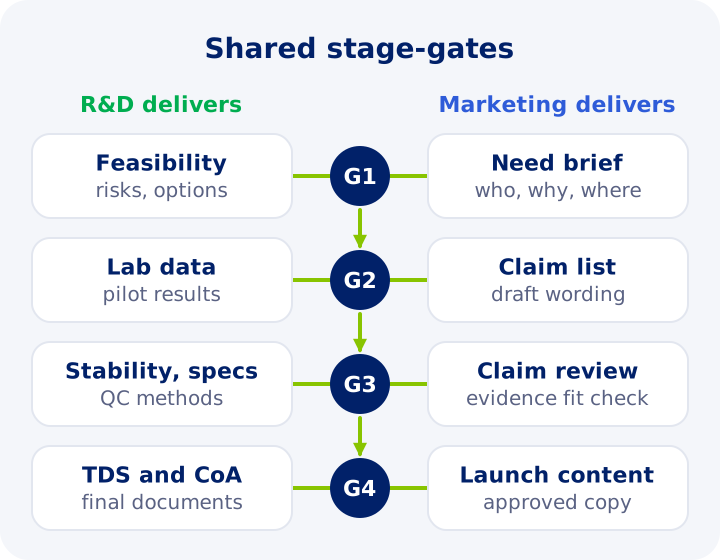
- Concept gate: R&D gives an honest feasibility view, including risks and alternatives. Marketing brings a need brief that says who the customer is, what problem they have and where the product will be sold.
- Development gate: R&D shares lab and pilot results. Marketing drafts a claim list that uses only what those results can support.
- Validation gate: R&D confirms stability, specifications and QC methods. Marketing and compliance check each claim’s wording against the evidence.
- Launch gate: final technical documents, such as the TDS and CoA, are released alongside approved launch content.
Who owns what
Unclear ownership is how unsupported claims slip through. A simple responsibility table, agreed at the start, removes most of that risk.
| Task | R&D | Marketing | QA and regulatory |
|---|---|---|---|
| Define the customer need | Advise | Lead | Inform |
| Generate test data | Lead | Request | Review methods |
| Draft claim wording | Check facts | Lead | Review |
| Approve claims per market | Sign off science | Sign off copy | Final approval |
| Update after changes | Flag changes | Update copy | Re-approve |
The last row matters most. Formulas, suppliers and regulations change, and someone must be responsible for spotting when a change affects a claim.
Translating a lab result into a claim
Good translation keeps the meaning and changes only the language. Work in three steps and keep all three in writing.
- Lab finding: “Protease activity is tested on every batch against a defined specification.”
- Plain meaning: “Each batch performs consistently because its strength is checked before release.”
- Claim: “Activity-standardised protease, tested batch by batch.”
Then reverse the check: does the claim say anything the lab finding does not? If yes, rewrite it or ask R&D whether more data can be generated. For health-related wording, add a compliance review, as described in our guide on how clinical data supports marketing claims.
Tip: Ask R&D to write one sentence on what the data does not show. That sentence prevents more over-claiming than any style guide.
Keep the feedback loop running
Launch is not the end of collaboration. Customers ask questions, sales teams meet objections, and those questions are valuable research briefs.
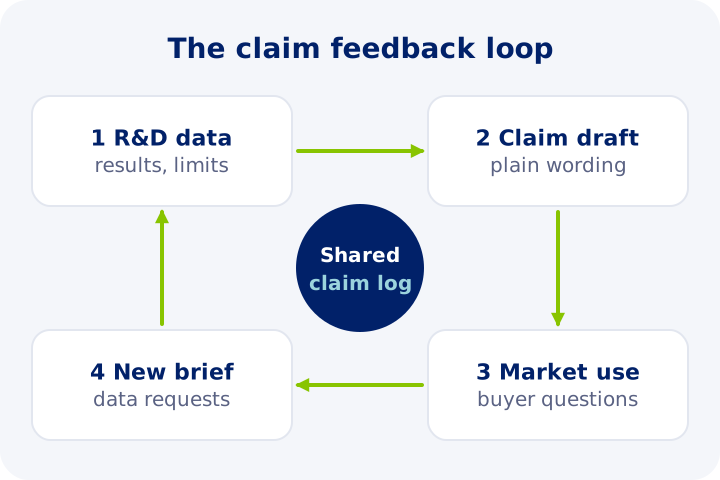
A shared claim log makes the loop work. For each claim it records the approved wording, the evidence, the approver, the date and the channels where it is used. When a buyer asks, for example, whether a probiotic strain keeps its count in a warm warehouse, the question goes into the log as a data request rather than being answered from memory.
Running joint reviews that work
Shared gates only help if the reviews themselves are productive. A few habits make a large difference:
- Circulate data and draft copy before the meeting, so time is spent on decisions rather than reading.
- Review claims against the original data, not against a summary of it.
- Record each decision in the claim log with a named owner and a date.
- Invite QA or regulatory reviewers to every gate where wording is discussed, not only the final one.
- Keep a short list of open questions and assign each one before the meeting ends.
When R&D and marketing disagree, the default should be the more cautious wording until more evidence is available. That rule removes much of the friction, because nobody has to win the argument; they only have to agree what data would settle it.
Measuring whether collaboration works
Collaboration is easier to sustain when you can see its effect. Useful indicators include how many claims are changed or withdrawn after launch, how long it takes to turn new data into approved wording, and how many customer questions can be answered directly from the claim log. Track these over successive launches. Fewer late changes and faster, confident answers to buyers are good signs that the process is working.
Red flags to watch for
- Claims written before any data exists.
- Different wording for the same claim on the pack, website and sales deck.
- R&D seeing launch copy for the first time after it is printed.
- Supplier documents, such as CoAs, older than the current specification.
- No named owner for updating claims after a reformulation.
Working with Enzyme Bioscience
Enzyme Bioscience works with customers’ R&D and marketing teams from the formulation stage, supported by our in-house R&D and QC labs. Through our ENZYVIVE® custom-blend service we develop enzyme and probiotic blends to your brief and supply the technical documents your claims depend on. To start, request samples, a TDS or a CoA.
Frequently asked questions
Early involvement lets R&D flag what the product can and cannot do before messaging is built around it. It also gives marketing time to request the data a claim will need, rather than discovering gaps just before launch.
A claim log is a shared, version-controlled list of every product claim, its approved wording, the supporting evidence and the person who approved it. Both teams use it as the single source of truth for packs, websites and sales material.
Work in three steps: state the lab finding, explain what it means in plain words, then write the claim and check it against the original data. If the plain-language version says more than the data shows, rewrite it or request more evidence.
At minimum, R&D confirms the science, QA confirms the product matches the specification, and a regulatory or compliance reviewer checks the wording for each market. Marketing owns the final copy but should not approve claims alone.
Useful supplier documents include technical data sheets, certificates of analysis, specifications and certification copies. Enzyme Bioscience provides samples, TDS and CoA on request to support customers' product development.