In this article
Enzymes have always been part of baking, because flour and yeast contain their own. What has changed is that bakers can now add specific enzymes in controlled amounts, at the right point in the process, for a specific result. This article follows bakery enzymes through the bake, explains why bread stales and how enzymes slow it, and shows how the choice of enzyme changes from one product to another.
What happens to enzymes during baking
An enzyme can only work while it is active, and it is only active within a certain range of temperature, water and pH. In a bakery that window runs from the mixer to the early minutes in the oven.
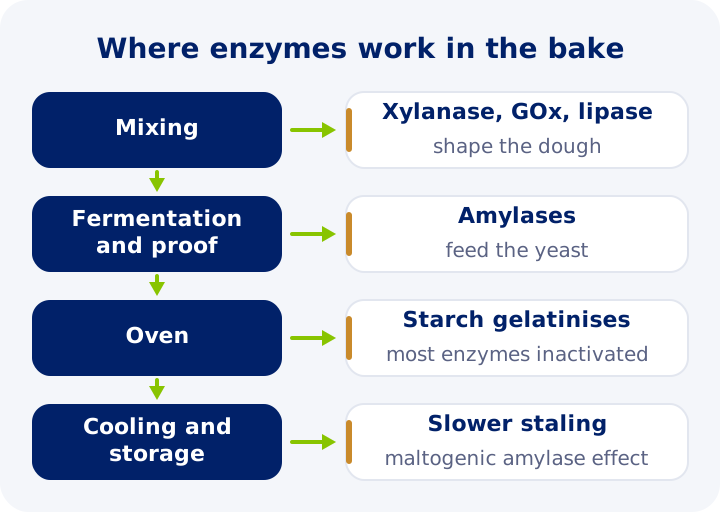
Mixing
Water activates the enzymes as soon as flour is hydrated. Xylanase redistributes water from arabinoxylans to gluten, glucose oxidase starts strengthening the gluten network, and lipase begins forming emulsifying lipids. The baker feels these changes as dough that is easier to handle, less sticky and more stable.
Fermentation and proof
Amylases break down damaged starch into sugars for the yeast. A steady sugar supply keeps gas production even, which matters for long or retarded fermentation. Any sugars left over contribute to crust colour.
The oven
As the dough heats, starch gelatinises and becomes much more accessible to amylases, but the enzymes are also starting to denature. Heat stability now decides the outcome:
- Fungal amylase is inactivated relatively early, so it has little effect on the baked crumb.
- Maltogenic amylase survives a little longer and acts on gelatinised starch, which is the basis of its anti-staling effect.
- Bacterial amylase is more heat-stable still. Too much can over-degrade starch and leave a sticky, gummy crumb.
Cooling and storage
By now the enzymes are inactive, but the changes they made to starch and lipids continue to affect how the crumb ages.
Why bread stales and how enzymes slow it
Many people assume stale bread has simply dried out. In fact the main cause is starch retrogradation. During baking, starch granules swell and their ordered structure breaks down. After baking, the starch molecules, especially the branched amylopectin, slowly reassociate and recrystallise. This makes the crumb firmer and less elastic, even if little moisture has been lost.
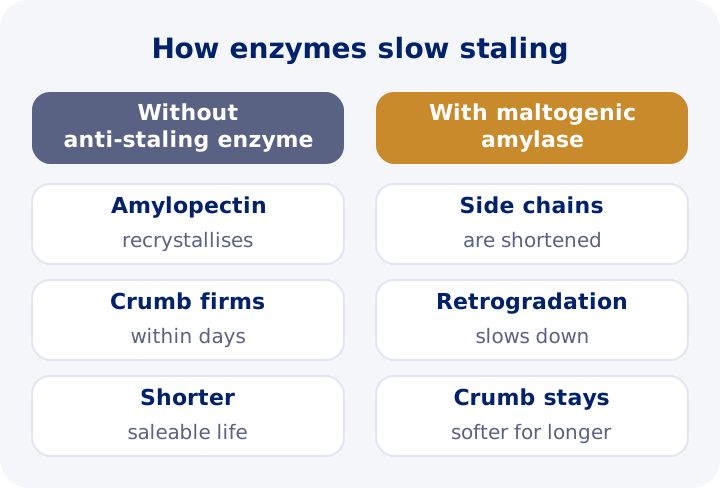
Maltogenic amylase trims the outer chains of amylopectin during baking. Shorter chains recrystallise more slowly, so the crumb stays soft for longer. Lipases contribute in a different way: the polar lipids they form can complex with starch and help keep the crumb tender.
Staling is not the same as spoilage. Anti-staling enzymes keep the crumb soft, but they do not stop mould growth, so longer softness must be matched by good hygiene, suitable packaging and, where needed, permitted preservation measures.
Matching enzymes to the product
The ideal enzyme system depends on what the product needs and which defect the baker wants to avoid.
| Product | Common challenge | Enzyme approach |
|---|---|---|
| Pan bread | Crumb firms within days | Maltogenic amylase, lipase |
| Wholemeal and high-fibre bread | Low volume, dense crumb | Xylanase, cellulase |
| Biscuits and crackers | Shrinkage, uneven shape | Protease |
| Gluten-free bread | Weak crumb structure | Transglutaminase |
| Frozen dough | Strength lost after thawing | Glucose oxidase, xylanase |
Bread and rolls
For everyday pan bread the main goals are volume, a fine crumb and a long soft life. A typical system pairs fungal amylase and xylanase for dough and volume with maltogenic amylase and lipase for softness.
Wholemeal and high-fibre bread
Bran particles absorb water and cut through the gluten network. Xylanase and cellulase help release water and soften bran fibre, which improves volume and crumb.
Biscuits, crackers and pastries
Here the goal is often a weaker, more extensible dough that holds its shape after sheeting. Protease relaxes gluten so cut pieces shrink less.
Gluten-free products
Without gluten, structure must come from other ingredients. Transglutaminase cross-links proteins such as egg or dairy proteins and can strengthen the crumb.
Frozen and par-baked dough
Ice crystals damage gluten and yeast during freezing. Strengthening enzymes such as glucose oxidase help the dough keep its volume after thawing.
Clean label and labelling
Because most enzymes are inactivated during baking, many markets treat them as processing aids rather than ingredients that must appear on the label. This is one reason enzymes are used to replace chemical oxidants and some emulsifiers in clean-label bread. The rules are not the same everywhere, however. Some markets require declaration in certain cases, and the carrier in an enzyme preparation, such as wheat flour, may have allergen implications. Before launching a reformulated product, confirm with your regulatory team how each enzyme and carrier must be treated in every country of sale, and ask your supplier for the composition, allergen statement and certifications of each preparation.
Getting dosage and control right
Enzymes are powerful at very low inclusion levels, so control matters:
- Know the flour. Falling number shows the flour’s own amylase activity. Protein content and water absorption affect how much strengthening or softening is needed.
- Dose carefully. Recommended ranges are a starting point only. Use the enzyme dosage calculator to plan batch quantities and confirm them by bake tests.
- Distribute evenly. Enzymes are usually dosed in a flour or starch carrier. Pre-blend them with part of the flour so small amounts spread evenly.
- Store properly. Keep enzymes cool and dry and use them within their shelf life.
Tip: When testing an anti-staling enzyme, measure crumb firmness on several days of shelf life, not just on day one. The difference often appears only after two or three days.
Working with Enzyme Bioscience
Enzyme Bioscience manufactures fungal and maltogenic amylase, xylanase, lipase, glucose oxidase and other bakery enzymes in Surat, India, under GMP and ISO 9001:2015, with Halal, Kosher and FSSAI certifications. We can also build an ENZYVIVE® custom blend around your product. Request a sample, TDS or CoA to start testing.
Frequently asked questions
Most bakery enzymes are proteins that lose activity as the crumb temperature rises during baking. Fungal amylase is inactivated relatively early, while maltogenic amylase and bacterial amylase are more heat-stable and keep working for longer. That difference in heat stability is used deliberately when choosing enzymes.
Staling is mainly caused by starch retrogradation: after baking, starch molecules, especially amylopectin, slowly recrystallise and the crumb firms. Moisture moving from crumb to crust adds to the effect. Bread can stale even when it has not dried out noticeably.
Maltogenic amylase stays active long enough during baking to act on gelatinised starch. It shortens the outer chains of amylopectin, which makes them less able to recrystallise. The crumb therefore firms more slowly and stays soft for longer.
Yes. Without gluten, the crumb structure depends on other proteins, starches and hydrocolloids. Transglutaminase can cross-link proteins such as egg or dairy proteins to build structure, and amylases can help with softness. Results depend strongly on the recipe, so trials are essential.
Bakery enzymes are proteins produced mainly by fermentation of selected microorganisms, and similar enzymes occur naturally in flour and yeast. Whether a product can be described as natural or clean label depends on local labelling rules and the full ingredient list, so check the regulations in your market.