In this article
Many procurement decisions in nutraceuticals start and end with one number: price per kg. But enzymes, probiotics, vitamins and many botanicals are not inert commodities. They lose activity over time, and how fast they lose it decides what a customer actually receives. This article explains why stability, not price per kg, determines the real cost of an ingredient, and how R&D and procurement teams can compare offers fairly.
Why price per kg misleads
A nutraceutical product is sold on what it delivers: a declared enzyme activity, a viable count or a vitamin content at the end of shelf life. The kilogram of raw material is only a carrier for that activity.
If one ingredient is cheaper but loses activity faster, the formulator has three choices, and all of them cost money. Add a larger overage, shorten the shelf life, or accept the risk of failing the label claim. A fair comparison therefore uses cost per active dose:
Cost per active dose = (price per kg ÷ activity per kg remaining at expiry) × activity per dose.
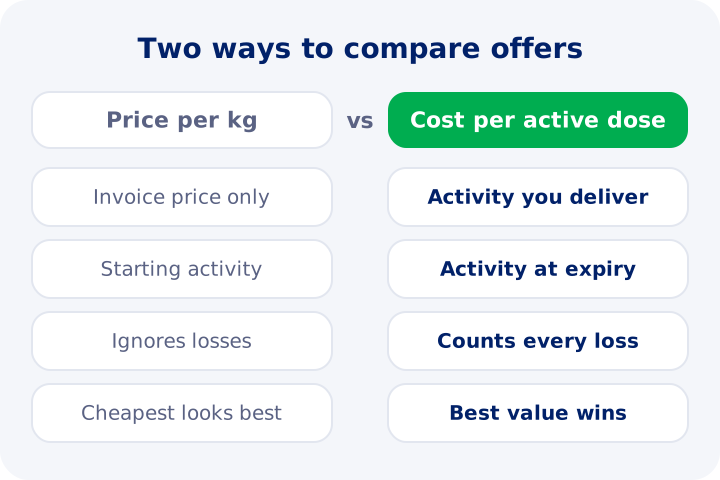
The figure that matters is the activity remaining at expiry in your formula and pack, which only stability data can provide. Our enzyme dosage calculator can help with the dose side of the calculation; the stability side has to come from testing.
What drives instability
Most potency loss comes from four environmental stressors, plus interactions inside the formula.
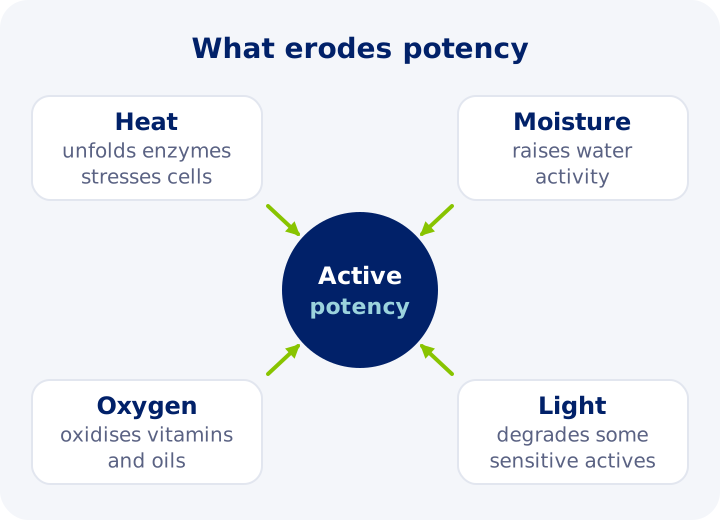
| Stressor | Most sensitive ingredients | Typical controls |
|---|---|---|
| Heat | Enzymes, vegetative probiotics | Controlled process and storage temperatures |
| Moisture | Probiotics, hygroscopic powders | Low-moisture excipients, desiccants, barrier packs |
| Oxygen | Anaerobic strains, vitamin C, oils | Nitrogen flushing, oxygen absorbers |
| Light | Riboflavin, some botanicals and pigments | Opaque or amber packaging |
| Interactions | Probiotics near acids or minerals | Compatibility trials, separation |
Enzymes
Enzymes are proteins, and their activity depends on their folded shape. Heat, extremes of pH and moisture can unfold that structure. Each enzyme has its own tolerance, so stability must be checked for the specific enzyme, form and formula rather than assumed from a general rule.
Probiotics
Live cultures are sensitive to moisture, heat and, for many strains, oxygen. Water activity is one of the most important factors in dry products: as it rises, viability tends to fall faster. Spore-forming strains such as Bacillus coagulans are generally more robust, which is why they are often selected for tablets, gummies and foods.
Vitamins and botanicals
Vitamin C and many polyphenols are prone to oxidation, oils can turn rancid, and some vitamins and pigments are light-sensitive. Off-odours and colour changes are often the first visible sign of a stability problem.
Overages: useful, but not a fix
An overage is extra active added at manufacture so the product still meets its label claim at expiry. Used properly, it is standard practice. Used to cover an unstable ingredient, it becomes expensive and unpredictable.
- Set overages from real stability data in the final formula and pack.
- Review them when the supplier, formula or packaging changes.
- Remember that a large overage raises cost per dose and may be questioned by customers or regulators.
Packaging is part of the formula
Packaging is often treated as a separate purchasing decision, but for sensitive actives it is part of the stability system. The same powder can keep its activity well in one pack and lose it quickly in another.
- Moisture barrier: high-barrier laminates, foil blisters or tightly closed containers slow moisture uptake.
- Oxygen control: nitrogen flushing and oxygen absorbers protect oxygen-sensitive strains, vitamins and oils.
- Light protection: opaque or amber packs shield light-sensitive vitamins and pigments.
- Desiccants: sachets or canisters help keep water activity low in bottles of capsules and tablets.
- Reclosure: once a bulk drum or retail pack is opened, how well it reseals affects everything that follows.
Always run stability studies in the exact pack you intend to sell, including closures and any desiccant.
Transport and storage count too
Ingredients and finished products spend time in trucks, ports and warehouses, where conditions can be harsher than the storage advice on the label. Heat and humidity during hot or monsoon seasons are a particular risk for live cultures and hygroscopic powders. Agree storage conditions with your logistics partners, use first-expiry-first-out stock rotation, and consider temperature monitoring for the most sensitive products. A stability study that ignores the supply chain can give a falsely reassuring result.
Designing a useful stability study
A stability study only answers the question you design it to answer. To be useful for purchasing and labelling decisions, it should:
- Test the finished formula in the final pack, not just the raw ingredient.
- Run real-time studies at the intended storage conditions for the full proposed shelf life.
- Add accelerated studies to flag problems early. A common accelerated condition, adapted from ICH pharmaceutical guidelines, is 40°C and 75% relative humidity.
- Track activity or viable count, plus moisture, appearance and odour, at defined time points.
- Use validated assay methods and keep them the same throughout the study.
Tip: Accelerated data is a warning system, not proof of shelf life. Confirm your label claim with real-time results before relying on it.
Questions to ask suppliers
- What activity or count remains at the proposed shelf life, and under which conditions?
- Which assay method was used, and can you share it?
- In which packaging and format was the stability study run?
- How consistent is starting activity from batch to batch?
- Is a certificate of analysis issued for every batch?
For a wider view of how premium brands assess suppliers, see our article on why premium brands pay for ingredient quality.
Common pitfalls
- Assuming lab-scale stability will hold in commercial production and distribution.
- Ignoring packaging as part of the stability system.
- Comparing suppliers whose activity figures use different assay methods.
- Forgetting transport and warehouse conditions, which can be harsher than the label storage advice.
- Choosing on price per kg and discovering the true cost only after a failed stability test.
Working with Enzyme Bioscience
Enzyme Bioscience produces enzymes and probiotic strains in a GMP, FDA-registered facility with in-house R&D and QC labs, and supplies them in 25/50 kg HDPE drums or retail pouches. Our ENZYVIVE® team can design custom blends around your stability requirements. To test our ingredients in your own formula, request samples, TDS and CoA.
Frequently asked questions
Price per kg ignores how much active material survives processing and storage. An ingredient that loses activity quickly needs a larger overage or a shorter shelf life, so its real cost per effective dose can be higher than a more stable but more expensive alternative.
The main stressors are heat, moisture, oxygen and light, plus interactions with other ingredients such as acids or minerals. Enzymes can lose activity when their protein structure unfolds, and vegetative probiotic cells lose viability when exposed to heat, moisture or oxygen.
An overage is extra active ingredient added at manufacture to compensate for expected losses, so the product still meets its label claim at expiry. It should be calculated from real stability data in the final formula and pack, and reviewed when the formula, supplier or packaging changes.
Ask for real-time data at the intended storage conditions, any accelerated data, the assay method used, the packaging tested and the activity or count remaining at the proposed shelf life. Then confirm the results in your own formula, because supplier data on the raw ingredient may not reflect your matrix.
Spore-forming strains such as Bacillus coagulans are generally more tolerant of heat and moisture than many vegetative lactic acid bacteria, which is why they are often chosen for shelf-stable formats. Their stability should still be confirmed in the specific product and pack.