In this article
In science-led industries, most brands publish similar datasheets full of activity units, counts and specifications. Facts are essential, but on their own they rarely make a brand memorable. Science-backed storytelling arranges verified facts into a clear narrative, so buyers understand why an ingredient matters to them and remember who explained it best.
Why specifications alone do not differentiate
A datasheet answers “what is it?” but not “why should I care?”. When three suppliers offer a protease with similar activity, the buyer cannot easily tell them apart from numbers alone. The supplier who explains the problem the enzyme solves, how it works and how to prove it in the buyer’s own process is usually the one remembered.
Storytelling here does not mean emotion instead of evidence. It means structure. A good science story takes the same facts that sit in a TDS and puts them in the order a reader needs: the problem first, then the mechanism, then the proof, then the outcome.
The evidence-led story arc
The simplest reliable structure has four steps. Each step answers one question in the reader’s mind.
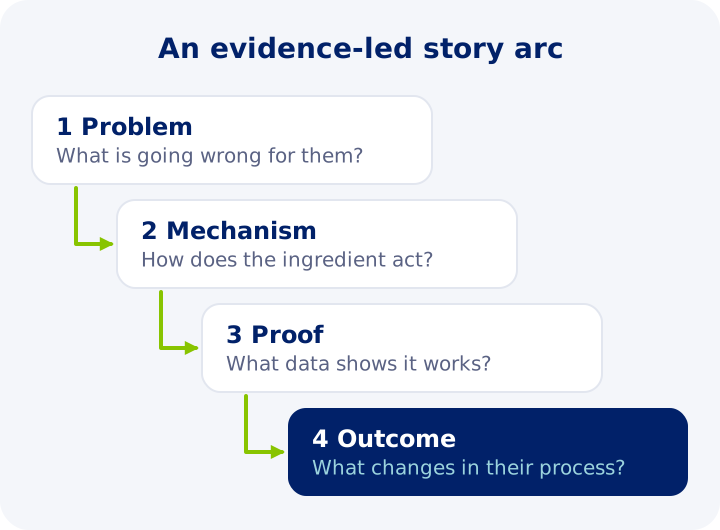
- Problem: what is going wrong for the customer? Be specific: bread that firms too quickly, feed that leaves phosphorus unused, a process that wastes energy.
- Mechanism: how does the ingredient act on that problem? Name the substrate and the reaction in plain words.
- Proof: what evidence shows it works? This can be published science, your own trial data or a recommended trial protocol for the customer.
- Outcome: what changes in the customer’s product or process, expressed as cautiously as the evidence requires?
Two worked examples
The arc works for almost any well-understood enzyme. Two examples show the pattern.
| Story step | Bakery: maltogenic amylase | Feed: phytase |
|---|---|---|
| Problem | Bread crumb firms during storage | Plant phosphorus is bound as phytate |
| Mechanism | Modifies starch to slow retrogradation | Hydrolyses phytate to release phosphate |
| Proof | Texture tests over shelf life | Feed trials and digestibility data |
| Outcome | Softer crumb for longer | Better phosphorus use from the diet |
In the bakery case, maltogenic amylase is a well-established anti-staling enzyme, and the proof step invites the baker to run texture tests on their own recipe. In the feed case, phytase releases phosphate from phytate, so nutritionists can review how much inorganic phosphorus the diet needs. In both examples, every line can be traced to accepted science or to a test the customer can run.
Tailor the emphasis, not the facts
Different readers care about different parts of the same evidence. A formulator wants the mechanism and how it fits the process. A QA manager wants specifications and test methods. A buyer wants consistency, supply security and cost per effective dose.
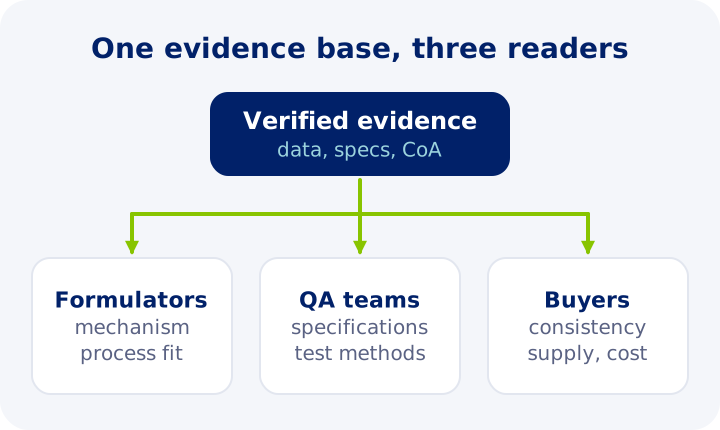
The rule is simple: you can change the order, depth and emphasis for each audience, but the core facts must be identical. If the sales deck, website and application note describe the same ingredient differently, credibility suffers. A shared claim log, described in our guide to collaborating with R&D teams, keeps every version aligned.
Guardrails that keep the story credible
A story is only an asset while it is trusted. These guardrails protect it:
- No invented anecdotes. Use real, permitted case data or describe a trial the customer can run themselves.
- No unquantified superlatives. Replace “the most advanced” with what the ingredient actually does.
- Match wording to evidence. For health-related products, follow the principles in how clinical data supports marketing claims.
- Show methods. Say how activity is measured and under which conditions.
- Respect health rules. Use “may support” language and never imply that a supplement treats or prevents disease.
Tip: Read each story aloud to a colleague from QA. If they ask "how do we know that?" at any point, add the evidence or remove the line.
Build a proof library
Stories are easier to tell, and harder to distort, when the supporting material is organised in one place. A proof library is a shared folder or database that sales, marketing and technical teams all draw from. It typically holds:
- Current TDS, specifications and recent CoAs for each product.
- Assay method summaries, so activity figures can be explained and compared fairly.
- Published references on the mechanism of each ingredient, with short plain-English summaries.
- Suggested trial protocols that customers can run in their own process.
- Approved claim wording and diagrams, with the date of approval.
Give each item an owner and a review date. When a specification or approved claim changes, the library changes first, and every story built from it follows.
Check whether the story is working
A science story succeeds when it changes what buyers do. Watch for signals such as more specific sample requests, fewer basic questions reaching the technical team, and customers repeating your explanation back in their own words. Listen too for confusion: if buyers keep asking the same question, the story has a gap. Treat those questions as the brief for the next application note.
Formats that carry science stories well
Science stories work best in formats that let readers check the facts:
- Application notes that follow the problem, mechanism, proof and outcome structure.
- Process-flow diagrams that show where an ingredient acts.
- Comparison tables, such as old versus enzymatic process, with short and specific cells.
- FAQs that answer the questions buyers actually ask.
- Sample kits with a TDS, a CoA and a suggested trial protocol.
The last format is often the most persuasive, because it turns the story into something the customer can test. Our bakery enzymes and other ranges are designed to be evaluated this way.
Working with Enzyme Bioscience
Enzyme Bioscience has supplied enzymes and probiotic strains since 2012, supported by in-house R&D and QC labs. We provide the technical facts your story needs, and our ENZYVIVE® service can develop a custom blend around a specific customer problem. To build your next application story on solid data, request samples, TDS and CoA.
Frequently asked questions
It is a way of presenting verified technical facts as a clear narrative: the customer's problem, how the ingredient works, what evidence supports it and what changes as a result. The story adds structure and relevance, not new claims.
Ordinary copy often leads with adjectives such as advanced or powerful. Science-backed storytelling leads with a real problem and a mechanism, and every statement can be traced to data, a specification or a published source.
Yes. Formulators, QA teams and buyers are people who remember a clear explanation better than a list of numbers. Application notes, process diagrams and worked examples are effective B2B story formats.
Avoid invented customer stories, unquantified superlatives, borrowed evidence from different ingredients or strains, and any wording that implies treating or preventing disease. Keep the same core facts across every channel.
We provide samples, technical data sheets and certificates of analysis on request, and our ENZYVIVE® service develops custom blends to a brief. These give your team accurate facts on which to build a product story.