In this article
- What should you check before choosing an Indian supplier?
- How do samples and trials work?
- Which documents travel with an enzyme shipment?
- What HS code applies to enzymes?
- Which Incoterms are common for enzyme imports?
- How should enzymes and probiotics be packed for export?
- What regulatory checks apply in the buyer’s country?
- Where does Enzyme Bioscience export?
- Working with Enzyme Bioscience
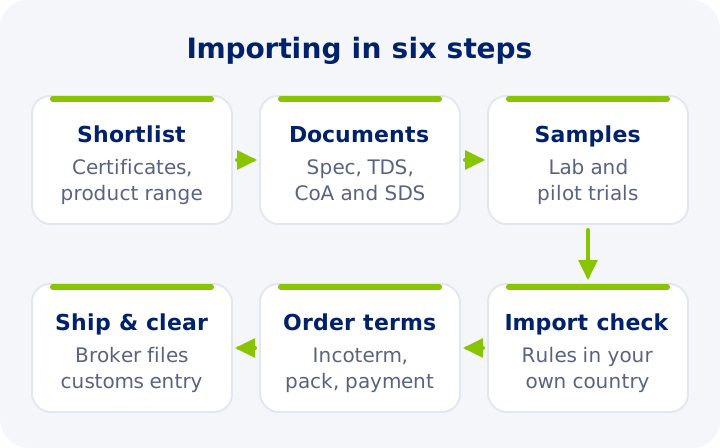
To import enzymes or probiotics from an Indian manufacturer, qualify the supplier on its certificates and documents, test samples in your own process, and confirm that the product is permitted for your intended use in your country. Then agree the specification, Incoterm, packaging and payment terms before the first order ships. Most enzymes clear customs under HS heading 3507, and each shipment should travel with a commercial invoice, packing list, transport document and a batch certificate of analysis (CoA).
This guide walks through each step from the buyer’s side, with the questions to ask and the documents to expect.
What should you check before choosing an Indian supplier?
A supplier shortlist should be based on evidence, not on a price list. India has an established fermentation and pharmaceutical-ingredients industry, so buyers can usually find several manufacturers for a given enzyme. The differences show up in quality systems, documentation and technical support.
| Check | What to ask for | Why it matters |
|---|---|---|
| Quality certificates | GMP, ISO 9001:2015, FDA registration | Shows the quality system behind each batch |
| Religious and local approvals | Halal, Kosher, FSSAI | Needed for many food and nutraceutical markets |
| Specification | Activity, unit, method, limits | Defines what you are buying |
| Batch documents | Sample CoA, TDS, SDS | Shows how results are reported |
| Export experience | Markets served, document routine | Reduces errors at customs |
Pay close attention to activity units. Enzymes are sold by activity, and an enzyme unit from one assay is not automatically equal to a unit from another. Ask which method the supplier uses, and compare offers only on the same basis.
For a fuller quality review, our enzyme supplier qualification checklist sets out the documents, audits and change-control points that QA teams usually cover.
How do samples and trials work?
Samples confirm that the product works in your process, not just on paper. Ask for a sample from a representative batch, together with its CoA and the technical data sheet (TDS). Then:
- Check the sample’s activity using the method stated on the specification, or agree an equivalent method with the supplier.
- Run a laboratory trial in your own substrate, at your own pH, temperature and time.
- Scale up to a pilot or plant trial before you commit to volume.
The enzyme dosage calculator can help you set a starting dose for trials. The final dose always depends on your substrate and process, so treat calculated figures as a starting point.
Tip: Keep part of the trial sample as a retained reference. If a later commercial batch behaves differently, you can test both side by side.
Which documents travel with an enzyme shipment?
An export shipment carries two groups of documents: product documents that describe the material, and shipping documents that customs and carriers need.
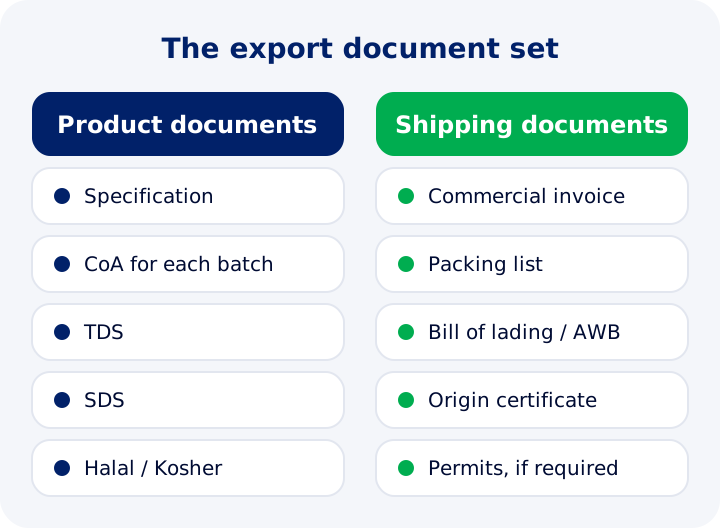
- Commercial invoice: the seller’s bill to the buyer, showing the product, quantity, value, currency and Incoterm. Customs uses it to assess duty.
- Packing list: the contents of each package, with gross and net weights and package marks.
- Bill of lading or air waybill: the transport document issued by the shipping line or airline. A bill of lading can also act as a document of title.
- Certificate of origin: a statement of where the goods were produced. Some trade agreements allow reduced duty when a valid certificate is presented.
- Certificate of analysis: batch-specific test results against the specification. See the glossary entry on the CoA.
- Technical data sheet and safety data sheet: the TDS describes typical properties and storage; the SDS describes hazards, safe handling and transport information.
Some importing countries also ask for permits, health certificates or free-sale certificates. Ask your customs broker which documents your country needs before the goods leave India, because missing paperwork is a common cause of delays.
What HS code applies to enzymes?
The Harmonized System (HS) is the international nomenclature that customs authorities use to classify goods. Enzymes and prepared enzymes fall under heading 3507:
- 3507.10: rennet and concentrates thereof.
- 3507.90: other enzymes and prepared enzymes not elsewhere specified.
Every country extends the six-digit HS code with its own national digits, which set the duty rate and any controls. Probiotics, enzyme-probiotic blends and finished dosage forms may be classified under different headings, depending on their composition and use. Confirm the classification with your broker before the first shipment, and make sure the code on the commercial invoice matches the one your broker will declare.
Which Incoterms are common for enzyme imports?
Incoterms are standard trade rules published by the International Chamber of Commerce. They define where the seller’s delivery obligation ends and who pays for freight, insurance and customs formalities. The current edition is Incoterms 2020.
| Incoterm | Seller delivers | Buyer arranges | Transport mode |
|---|---|---|---|
| EXW (Ex Works) | At the seller’s premises | Export clearance, all freight | Any |
| FCA (Free Carrier) | To the buyer’s carrier | Main freight, insurance | Any |
| FOB (Free On Board) | On board the vessel | Sea freight, insurance | Sea only |
| CIF (Cost, Insurance and Freight) | On board, freight and insurance paid | Import clearance, delivery | Sea only |
| DAP (Delivered At Place) | At the named destination | Import clearance, duties | Any |
FOB and CIF are designed for sea and inland waterway transport. For air freight, many traders use FCA, CPT or CIP instead. With Enzyme Bioscience, the Incoterm, lead time, minimum quantity and payment terms are agreed per order, on request.
How should enzymes and probiotics be packed for export?
Enzyme activity and probiotic viability are both sensitive to moisture and heat, so packaging matters on a long journey. Enzyme Bioscience packs in 25 kg or 50 kg HDPE drums, or in retail pouches for finished products. When you agree packaging, cover:
- Moisture protection: sealed inner liners and tightly closed drums limit moisture uptake in transit and storage.
- Temperature: agree whether the product needs temperature-controlled shipping. Many probiotic powders have stricter storage recommendations than enzymes, while spore-forming strains are generally more robust.
- Labelling: each pack should show the product name, batch number, dates, net weight and storage conditions, matching the CoA and packing list.
- Handling: enzyme powders can cause respiratory sensitisation, so the SDS should travel with the goods. Section 14 of the SDS gives the transport classification.
What regulatory checks apply in the buyer’s country?
The importer, or the brand owner, is responsible for confirming that the product is permitted for its intended use in the destination market. The rules depend on the use:
- Food enzymes: many markets regulate enzymes used in food. In the European Union, food enzymes are covered by Regulation (EC) No 1332/2008.
- Feed enzymes: feed additives usually need authorisation. In the EU this falls under Regulation (EC) No 1831/2003.
- Pharmaceutical enzymes: active ingredients must meet the pharmacopoeial grade and registration requirements of the medicine they go into.
- Probiotics and supplements: rules on strains, labelling and claims vary widely. In parts of the EU, for example, the word “probiotic” itself can be treated as a health claim.
- US imports: facilities that manufacture food for the US market must be registered with the US FDA.
Your supplier can provide specifications, certificates and statements to support your review, but it cannot confirm local legal status for you. Where the rules are unclear, ask a regulatory consultant in your own market.
Where does Enzyme Bioscience export?
Enzyme Bioscience serves customers in 21 countries, including Sri Lanka, Bangladesh, China, South Korea, Japan, Taiwan, the Philippines, Vietnam, the UK, Spain, Italy, Russia, Türkiye, Egypt, South Africa, Zimbabwe, the USA, Canada, Brazil and Peru. Our global supply page explains how we work with overseas buyers, and the certification page lists our quality approvals.
Working with Enzyme Bioscience
We manufacture enzymes, probiotics and custom blends in an FDA-registered, GMP facility in Surat, Gujarat, with in-house R&D and QC laboratories. Browse the product finder, then request samples, TDS and CoA for your trials. Commercial terms are agreed per order.
Frequently asked questions
Start by qualifying the supplier on its certificates and documents, then test samples in your own process. Confirm that the product is permitted for your intended use in your country, agree the specification, Incoterm, packaging and payment terms, and appoint a customs broker to clear the shipment on arrival.
Enzymes and prepared enzymes are classified under HS heading 3507. Subheading 3507.10 covers rennet and its concentrates, and 3507.90 covers other enzymes and prepared enzymes. Each country adds its own digits to the six-digit code, so the importer's customs broker should confirm the full national tariff line.
A typical export shipment travels with a commercial invoice, a packing list, a bill of lading or air waybill and, where requested, a certificate of origin. The product documents are usually a certificate of analysis for each batch, plus the technical data sheet and safety data sheet. Some importing countries ask for extra documents, such as permits or health certificates.
The right Incoterm depends on how much of the freight, insurance and customs work the buyer wants to handle. EXW and FCA leave most of the logistics to the buyer, FOB and CIF are designed for sea freight, and DAP places more of the transport responsibility on the seller. The chosen rule should be agreed in writing for each order.
It depends on the strain, the format and the supplier's storage recommendation. Spore-forming probiotics are generally more tolerant of heat and moisture than many lactic acid bacteria, which can be more sensitive. Agree the storage and shipping conditions with the supplier before ordering and store the product as recommended on arrival.
The importer or brand owner is responsible for confirming that an enzyme or probiotic is permitted for its intended use in the destination country. The manufacturer can supply specifications, certificates and technical documents to support that review, but cannot confirm local regulatory status on the buyer's behalf.