In this article
Plant ingredients such as wheat bran, sunflower meal, rice bran, DDGS and forages are rich in fibre, and much of that fibre is cellulose. Animals cannot break cellulose down on their own, and the fibre also locks other nutrients inside plant cells. Adding cellulase enzyme to animal feed helps open that structure so that more of the diet’s energy and protein becomes available.
What cellulose is and why it limits digestion
Cellulose is a long, straight chain of glucose units joined by β-1,4 bonds. The chains pack tightly together into microfibrils, which form the framework of plant cell walls alongside hemicelluloses (such as arabinoxylans and β-glucans), pectins and lignin.
Mammals and birds do not produce enzymes that can break β-1,4 bonds. This creates two problems in feed:
- Cellulose itself is poorly used. In pigs and poultry, much of it passes through or is only partly fermented in the hindgut.
- Nutrients stay trapped. Starch granules and protein bodies inside intact cell walls are partly shielded from the animal’s own amylase and protease. Nutritionists call this the “cage effect”.
Ruminants are different. Their rumen microbes produce cellulases, which is why cattle, sheep and goats can live on forage. Even so, forage fibre digestion is incomplete, especially as plants mature and lignify.
How the cellulase complex works
“Cellulase” is really a team of enzymes with complementary roles. Commercial cellulase products contain a mix of these activities, usually produced by fermentation of fungi or bacteria.
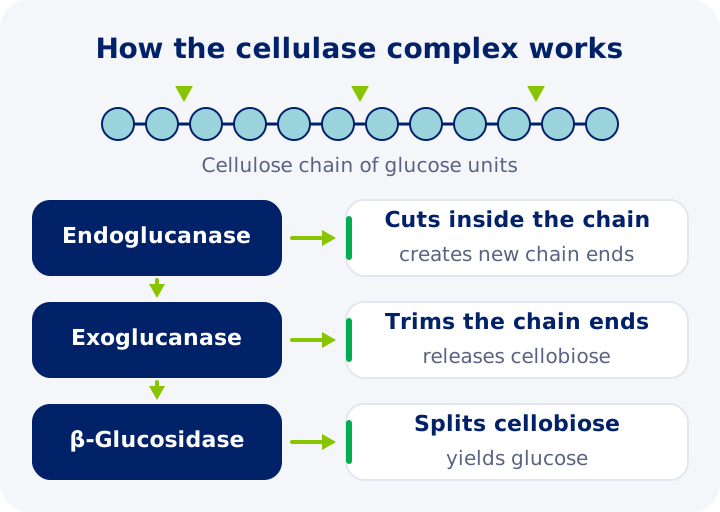
Endoglucanase
Endoglucanases cut β-1,4 bonds at random points inside the cellulose chain, mainly in less ordered regions. Each cut creates new chain ends and loosens the fibre structure.
Exoglucanase (cellobiohydrolase)
Exoglucanases work from the chain ends, releasing cellobiose, a two-glucose unit. The more ends the endoglucanase creates, the faster the exoglucanase can work.
β-Glucosidase
β-Glucosidase splits cellobiose into two glucose molecules. This also stops cellobiose from building up, which would otherwise slow the other two enzymes.
In feed, the full conversion to glucose matters less than the first steps. Even partial breakdown of the cell wall is enough to let digestive enzymes reach the starch and protein inside.
Releasing nutrients trapped in cell walls
The biggest benefit of cellulase in feed comes from disrupting the cell-wall cage rather than from the glucose it releases.
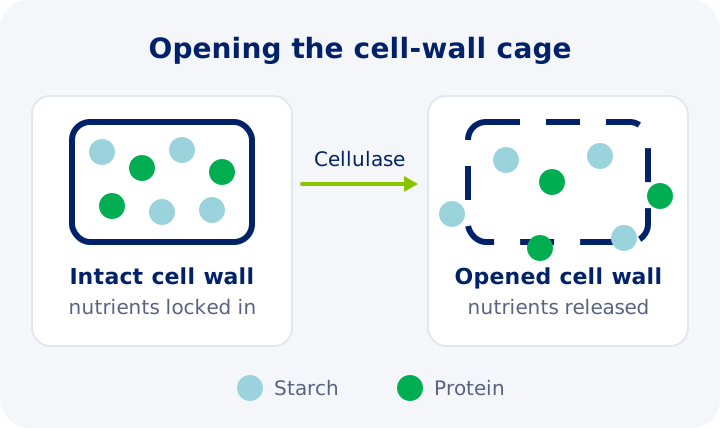
Because cell walls contain several types of fibre, cellulase is rarely used alone. Xylanase breaks arabinoxylans, β-glucanase breaks β-glucans and mannanase breaks β-mannans. Together they degrade the wall more effectively than any single enzyme, which is why most feed carbohydrase products are multi-enzyme blends.
Cellulase in different livestock diets
| Animal group | Fibre digestion without added enzyme | Role of added cellulase | Common partner enzymes |
|---|---|---|---|
| Broilers and layers | Very limited; short hindgut fermentation | Opens cell walls, releases trapped nutrients | Xylanase, β-glucanase |
| Pigs | Partial, mainly hindgut fermentation | Better use of fibrous ingredients | Xylanase, mannanase |
| Ruminants | Rumen microbes digest fibre | May aid early fibre breakdown; responses vary | Xylanase |
| Fibrous by-products (pre-treatment) | Low digestibility as fed | Partial breakdown before feeding | Xylanase, β-glucanase |
Poultry
Poultry diets increasingly include by-products such as rice bran, sunflower meal and DDGS. Cellulase, in combination with xylanase, helps release energy and protein from these ingredients and supports more consistent performance when ingredient quality varies.
Pigs
Pigs ferment some fibre in the large intestine, but nutrients released there are used less efficiently than those absorbed in the small intestine. Breaking down fibre earlier helps, particularly for weaned piglets and in diets with high levels of by-products.
Ruminants
For ruminants, exogenous fibrolytic enzymes are added to total mixed rations or applied to forages before feeding. Published results vary with forage type, enzyme product and application method, so on-farm validation is essential.
Acid and neutral cellulase
Cellulases differ in the pH range where they are most active. Acid cellulase works best in mildly acidic conditions, while neutral cellulase is more active closer to neutral pH. Choose the type whose activity profile matches the environment where it needs to work, whether that is a stage of the digestive tract or a pre-treatment process for fibrous ingredients. The technical data sheet should show activity across pH and temperature.
Using cellulase well
- Match the blend to the formula. Identify the main fibre sources in the diet and choose partner enzymes accordingly.
- Protect activity during processing. High pelleting temperatures can reduce enzyme activity. Use heat-tolerant products or post-pelleting liquid application.
- Plan the dose. Dosage depends on the enzyme’s activity, the fibre level and the species. Use the enzyme dosage calculator for planning and confirm it in trials.
- Measure the right outcomes. Track feed conversion, weight gain, uniformity and, in poultry, litter quality, alongside feed cost per unit of output.
Tip: When comparing cellulase products, ask how activity is measured. Different assays use different substrates, so a figure from one supplier cannot be compared directly with another's.
For a wider view of how cellulase fits alongside phytase, protease and other feed enzymes, see our guide to the benefits of enzymes for livestock health.
What to check on a cellulase TDS
Before running a trial, review the technical data sheet for:
- Activity and assay. The unit definition, substrate and assay conditions used to measure activity.
- pH and temperature profile. Where the enzyme is most active, and how quickly activity falls outside that range.
- Side activities. Many cellulase products also contain xylanase or β-glucanase activity, which can be useful in mixed-fibre diets.
- Heat stability. Data on activity retained after pelleting or heat exposure.
- Form and carrier. Powder or liquid, and what the enzyme is carried on.
- Storage and shelf life. Recommended storage conditions and expected activity over time.
Working with Enzyme Bioscience
Enzyme Bioscience produces acid and neutral cellulase, xylanase, β-glucanase, mannanase and other feed enzymes in Surat, India, under GMP and ISO 9001:2015. Our ENZYVIVE® service can combine them into a blend matched to your ingredients. Request a sample, TDS or CoA to start a trial.
Frequently asked questions
Cellulase breaks down cellulose, the main structural fibre in plant cell walls. In feed, its chief benefit is opening those walls so that starch, protein and other nutrients trapped inside become easier for the animal to digest. It is usually combined with other fibre-degrading enzymes.
Only to a limited extent. Pigs and poultry do not produce cellulase themselves; some fibre is fermented by microbes in the hindgut, which is more developed in pigs than in poultry. Added cellulase helps break down fibre earlier in the digestive tract, where the released nutrients can be absorbed.
Rumen microbes already produce cellulases, so responses to added enzymes vary with the forage, the enzyme product and the feeding system. Fibrolytic enzymes are studied for improving forage digestion and for treating forages before feeding, but results should be confirmed on farm.
The two differ mainly in the pH range where they are most active. Acid cellulases work best in mildly acidic conditions, while neutral cellulases are more active closer to neutral pH. Choose the type whose activity profile matches where the enzyme needs to work, and check the pH curve in the technical data sheet.
Xylanase, β-glucanase and mannanase are common partners, because plant cell walls contain hemicelluloses as well as cellulose. Phytase and protease are often added to the same diet for their separate benefits. A combined product or custom blend can be matched to the main ingredients in the formula.